Miss World – Megan Young
Megan Young,
our representative to the Miss World beauty pageant held in Indonesia was
recently crowned as Miss World 2013. This is the first time that a Filipina won
this event. After 62 years of excruciating agony hoping to hold that magic
wand, sit in the golden chair, and wear that diamond crusted crown, we can
finally say “Yes, we did it!” Or should we say, Megan Young did it for us.
 |
| photo by Murdani Usman, Reuters |
Her hard work,
sacrifice and passion carried us on to win the event. Once again, we are
beaming with pride and honor. Before the pageant, she posted on her official Miss World - Philippines Facebook account, “Sa aking mga
kababayan, huwag kayong mawalan ng pag-asa. May bukas pa at may laban pa tayo.
Taas noo tayong lalaban pero tayo’y magpakumbaba pag dating sa ating mga
salita. Buong puso ko at puso niyo ang lumalaban dito. Itong laban na ito ay
para sa ating lahat. Sana makapagbigay inspirasyon ako sa lahat ng Pilipino
katulad rin ng aking mga iniidolo na lumaban para sa bansa. Laban, Pilipinas.” Yes, Megan. Your fight is our fight. Your battle is
our battle. Together, as one united Filipinos, you as our representative and we
as your avid supporters with undying fervor to support you, we can overcome the
hurdles and challenges in the international competition.
More
importantly, the win mirrors the resiliency of the Filipinos who in spite of
their struggles continues to endeavor to be triumphant and victorious in the
game of life.
To Megan Young, thank
you for bringing honor and pride to our country. You did inspire all of us. Kay
sarap maging Pilipino, taas noo kahit kanino.
Source: Rappler
2nd Place, FIBA Asia 2013
The victory
of Smart Gilas over South Korea is still fresh in my memory. The fearless
drives of Jason Castro, the clutch three point shots of Jimmy Alapag and
jumpers of Ranidel, the hustle of Marc Pingris and the passion of the Filipinos.
I watched the encounter through streaming videos. It’s a little bit
blurred but enough to see the action and recognize the players. Besides, this
is a game where we can take off the monkey on our back and reassert ourselves
in the world basketball. It’s about damn time that we should beat this pesky
and sweet shooting Koreans. With 20,000 plus screaming fans supporting our
players inside the Mall of Asia , the family’s moral support, and the 90
million plus rooting and praying to beat the Koreans, this is the best opportunity
to finally exorcise the demons against the Koreans.
 |
| photo credit: FIBA Asia/Nuki Sabio |
Korea was ahead 28-23 when Douthit got injured halfway through the
second quarter. Wow, can you believe that? Our main man in the middle was gone! I felt
right there that our chances of winning got diminished.
But the players never gave up. Who could forget the daredevil drives of
Jason Castro in the opening of third quarter? He is one of the smallest on the
court and yet he stands tall amongst them. Ping muscled his way under the rim
against taller Koreans to rebound, defend and score. At the end of 3rd
quarter, we’re up by 9 points.
And then it happened. With over four minutes remaining, that Korean
player with a tomahawk hairstyle (Lee Seung-Jun) dunked
the ball to give the Koreans a one point lead. Oh boy, here we are again! Those
demons just won’t go away. Those heartbreaking losses resurfaced again in my head.
No, this ain’t happening!
Less than a minute to go, Philippines is up by two. Jimmy dribbled his way to the left side and
shot a three, a form we are too familiar watching in PBA. He nailed it and we’re
up by five points. The ensuing play is a blocked of Norwood against a Korean shooter.
As the final seconds ticked away, people start hugging one another as tears
flows. Coach Chot sobs at the sidelines, some players jumped in joy; others
knelt down savoring the liberation of winning against South Korea.
The historical importance of the win cannot be overemphasized. For
decades, we are the kings of Asia. From 1936 to 1972, we represented Asia in
Olympic basketball except for one. Since then, we’ve never been in the world.
We’ve never beaten South Korea in international competition since 1985,
a 28 long years of fruitless endeavor. As a hoops mad nation, getting over the
hump is a welcome relief everyone relishes. Heartbreaks includes 2011 FIBA Asia Championship, 2010
Asian Games, 2009 FIBA Asia Championship, 2002 Asian Games, 1998 Asian Games, 1987
Asian Basketball Confederation Championship, and 1986 Asian Games.
Source: Grantland,GMA News and Interaksyon
Miss Supranational –
Mutya Datul
Okay, I know this title is not as popular and prominent as the other
three beauty pageants, Miss World, Miss Universe and Miss International but
then again when you bested 82 other beauties from different nationalities, it’s
something to be proud of.
Never heard or seen her? Here is a glimpse of her beauty. Ganda talaga ng
lahi natin ano po? :-)
 |
| photos c/o Raymond Saldana. |
Source: Rappler
GDP, best in Asia
Philippines 2nd
quarter 2013 GDP grew by 7.5%. Several highlights on this glowing numbers are:
 |
| Source:NSCB |
a.
It
beat the analysts median forecast of 7.2%.
b.
This
is the 4th consecutive quarter that the GDP expanded by at least 7%.
c.
The
highest among ASEAN nations.
d.
It
matched China’s GDP, highest in Asia.
e.
The
composition of the growth points towards the process of rebalancing; from being
a consumption led economy to investment-led and industrialized.
It wasn’t too
long ago when Philippines was tagged as the “sick man” of Asia. Today, analysts
and investors alike are singing a different tune. Philippines is Asia’s newest bright
spot. Philippines is Asia’s Rising Economic Star. The strong man of Asia. Philippines
is the investors’ darling in Asia, its economy shines amid a backdrop of slower
growth in the global economy.
HSBC predicted Philippines to become the 16th
largest economy by 2050 with an average growth of 7% until 2050.
Source: NEDA, Inquirer
PSE, 3rd Best Performing
Stock Market
Paris-based World Federation of Exchanges (WFE) recognized
Philippine Stock Exchange as the 3rd best performing stock for the
year 2012. It follows Turkey and Thailand respectively.
 The PSE was recognized after it gained 38.9% in market capitalization.
The value turnover increased by 25.3% in 2012, 3rd best in the world.
PSE landed fourth in the expansion of number of trades while it registered
fifth highest increase in broader market index.
The PSE was recognized after it gained 38.9% in market capitalization.
The value turnover increased by 25.3% in 2012, 3rd best in the world.
PSE landed fourth in the expansion of number of trades while it registered
fifth highest increase in broader market index.
In 2012, our PSEi recorded 33% gain, enough to land the 10th
spot lead by Venezuela’s Index which increased by a whopping 303%.
In 2013, the PSEi still fairs well among the best performing stock
market as it gains 20% as of Apr 2013 to land at fifth spot, this time lead by
Japan with a gain of 34% year to date.
Source: GMA News, Business Insider, Rediff
Interest Rates at Historic Low
Current
interest rate is at 3.5%, the lowest rate in history since data were compiled.
Recently, Bangko Sentral ng Pilipinas kept the interest rate
at 3.5% to support GDP growth.
 The interest
rate refers to the central bank benchmark interest rate. Usually, the central
bank benchmark interest rate is the overnight rate at which central banks make
loans to the commercial banks under their jurisdiction. Moving the benchmark
interest rate, the central bank is able to make an impact on interest rates of
commercial banks, inflation level of the country and national currency exchange
rate.
The interest
rate refers to the central bank benchmark interest rate. Usually, the central
bank benchmark interest rate is the overnight rate at which central banks make
loans to the commercial banks under their jurisdiction. Moving the benchmark
interest rate, the central bank is able to make an impact on interest rates of
commercial banks, inflation level of the country and national currency exchange
rate.
Reduction of interest rates should bring increase in business activity, a
rise in inflation rate and weakening of national currency. In case of increase
in interest rates the level of business activity is likely to drop, inflation
declines and national currency strengthens.
Source: BSP,Trading Economics, Bloomberg
Now, A Lender to IMF
We’ve been
the recipient of these IMF loans before, it’s time that we turn back the favor
and help struggling countries.
Our GIR is at
historic levels as dollars from OFWs and BPOs sector increase the net dollar
inflow of our country.
First Ever Investment Grade
Philippines
never achieved an Investment Grade from the three major credit agencies. Moody’s
and S&P started covering Philippines in 1993 while Fitch in 1999. Since
these three major credit agencies started covering Philippines credit, we’d
never passed the speculative grade. The highest grade we got was a notch below
the investment grade.
Until 2013
came. Last March this year, Fitch gave Philippines its first ever investment
grade rating. S&P followed suit in May. Moody’s team is expected to follow
suit.
 |
| Source:Philstar |
An investment grade rating would lower debt interest
payments, open more credit avenues, and give the country more foreign
investments.
Source:SEPO, PhilStar

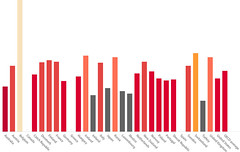
 Okay, GDP is supposed to stand seriously for Gross Domestic Product and GNP, for Gross National Product. But many of us do not seem to understand what they really mean, and Filipino ingenuity came up with Gawa Dito sa Pilipinas and Gawa Ng Pilipino! Very cute, I must say! Are they correct, though?
 The residency status of producers of goods and services determines the limits of domestic production and affects the measurement of GDP. In the context of the SNA, residency is not based on nationality. An institutional unit producing goods and services in the economic territory of a country is said to be a resident producer if it has a center of economic interest in that economic territory. Usually, this is interpreted to mean that the institutional unit engages or intends to continue to engage, in economic activities and transactions on a significant scale, either indefinitely or over a finite but long period of time, generally one year or more.
 their green bucks here. So, our kababayans who are working hard, earning honest money and living abroad would help us if they continued to send and invest their dollars, euros, dinars, yens, etc. in our country. On the other hand, the services provided in construction projects in the Philippines like the Metro Tren, by foreign consultants who do not establish residence here are not part of our GDP or GNP; they are not Gawa Ng Pilipino, although they are Gawa Dito sa Pilipinas! They are part of the GNP of the foreign consultants’ country.